Reconstituting a lyophilised retatrutide vial is mechanically straightforward, but small technique mistakes — shaking instead of swirling, using the wrong solvent, failing to label — compound into real dosing and sterility problems. This walkthrough breaks the process down into named steps and lists the four most common mistakes that account for the majority of ruined vials.
Key Takeaways
- Use bacteriostatic water, not sterile water. The benzyl alcohol preservative is what makes a multi-dose vial safe over four weeks.
- Add water slowly down the vial wall. This minimizes foam and shear on the lyophilised cake.
- Swirl, never shake. Shaking introduces air and can damage peptide structure.
- Label with date and concentration. Four weeks goes by fast; mg/mL is what every dose depends on.
- Refrigerate at 2–8°C. Reconstituted peptide should go in the fridge, not left at room temperature.
- Discard on sight of cloudiness or particulate. Any visual change ends the vial.
Equipment list
Before touching the vial, assemble everything you need. Working in a clean, well-lit area with no distractions reduces mistakes.
| Item | Purpose | Notes |
|---|---|---|
| Lyophilised retatrutide vial | Peptide source | Check expiry; store sealed vial refrigerated or per supplier guidance. |
| Bacteriostatic water vial | Reconstitution solvent | ~0.9% benzyl alcohol. Not sterile water, not saline. |
| 1 mL or 3 mL draw syringe with needle | Transfer BAC water into peptide vial | 21–25G works for transfer. One per reconstitution event. |
| Alcohol prep pads | Wipe vial septa | Let dry for 15–30 seconds before puncturing. |
| U-100 insulin syringe (29–31G) | Dose withdrawal | For later dose draws; not for reconstitution itself. |
| Sharps container | Needle disposal | Immediately after use, never recap. |
| Label and pen | Record date and concentration | Masking tape works if no supplier label is included. |
Step 1 — Prep the vials
Wash hands. Remove the flip caps from the lyophilised retatrutide vial and the bacteriostatic water vial, exposing the rubber septa. Wipe each septum with a fresh alcohol pad and let it air-dry for about 15–30 seconds. Do not fan dry — that recontaminates the surface.
Step 2 — Draw the bacteriostatic water
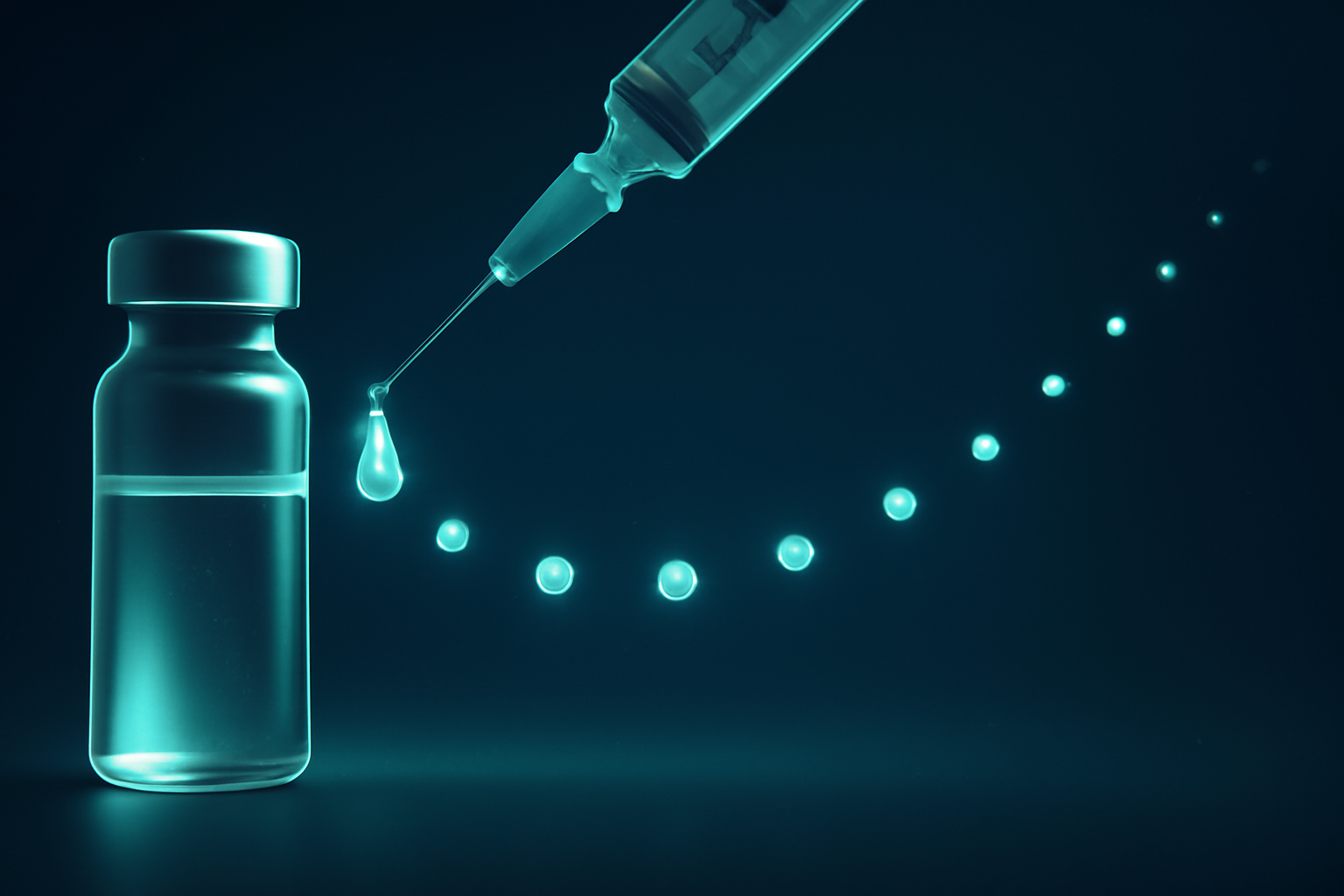
Insert the draw syringe needle into the BAC water vial. Invert the vial. Draw the exact volume of bacteriostatic water you decided on (commonly 1, 2, or 3 mL for a 10 mg peptide vial — see the dedicated reconstitution-math article for syringe-mark charts).
While still in the vial, tap gently to float any air bubbles upward and push them back out of the syringe. You want an accurate volume because it defines the mg/mL concentration of the finished mix.
Step 3 — Add the water into the peptide vial, slowly
Insert the needle into the retatrutide vial at a slight angle so the stream of water runs down the inside wall of the glass rather than onto the lyophilised cake directly. Depress the plunger slowly, over about 10–20 seconds. The point is to let the water dissolve the peptide gently without churning foam into it.
Once the syringe is empty, withdraw the needle, discard into the sharps container, and move on. Do not re-use that syringe for the dose.
Step 4 — Swirl, do not shake
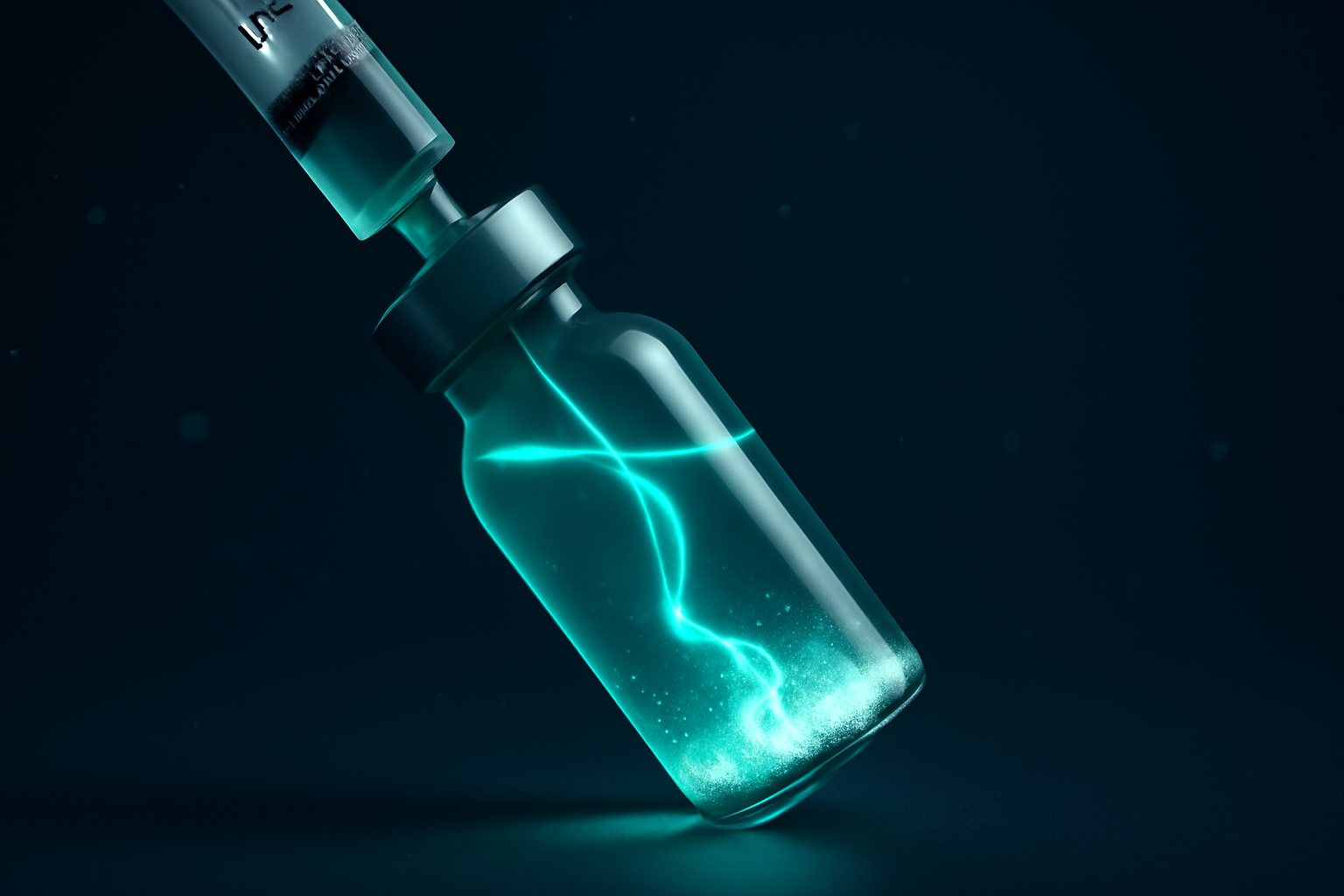
Hold the retatrutide vial by the cap and swirl it in slow, small circles for 20–60 seconds. The lyophilised cake should dissolve into a clear, colorless solution within 1–2 minutes. If pieces of cake persist, swirl longer. Shaking vigorously is the single most common cause of ruined vials — it introduces air and shear that can damage the peptide.
Step 5 — Inspect the solution
Hold the vial up to light. A correctly reconstituted peptide solution should be clear and free of particulate. Cloudiness, haze, visible flakes, or discoloration mean the vial should be discarded. If the solution looks right, move to labelling.
Step 6 — Label and refrigerate
Stick a label on the vial that captures three things:
- Date of reconstitution.
- Concentration in mg/mL (total mg ÷ mL BAC water added).
- Discard-by date, typically 28 days after reconstitution.
Place the vial in the refrigerator at 2–8°C. Avoid the door shelf where temperature cycles most and freezer compartments where the vial could freeze and damage the peptide.
Stability window and signs of degradation
The commonly used stability window for a BAC-water-reconstituted peptide vial is roughly 28 days refrigerated. That number is anchored on the FDA labelling convention for bacteriostatic water as a multi-dose carrier, not on retatrutide-specific stability studies, so treat it as a conservative guide.
| Time point | What should be true | Red flags |
|---|---|---|
| Day 0 (freshly reconstituted) | Clear, colorless solution; cake fully dissolved | Any residue cake fragments; cloudy mix |
| Days 1–14 | No visual change; stored at 2–8°C | Any precipitate; strange odor on puncture |
| Days 14–28 | Still clear; no sediment | Haze, visible particulate, or yellowing — discard |
| After day 28 | Discard regardless of appearance | Do not extend window on visual inspection alone |
Four most common reconstitution mistakes
- Using the wrong solvent. Sterile water (no preservative) is single-use only. Saline is not an appropriate solvent for lyophilised peptides. Only bacteriostatic water should be used for a multi-dose vial.
- Shaking. Shaking foams the mix and can denature the peptide. Always swirl.
- Failing to label. Without the reconstitution date and mg/mL on the vial, every subsequent dose becomes guesswork.
- Poor sanitation. Puncturing a septum that was not wiped with alcohol, or re-using a syringe, defeats the whole point of bacteriostatic water.
Why slow addition matters
The reason to let the bacteriostatic water run down the inside wall of the vial rather than squirting it onto the lyophilised cake is twofold. First, direct impact on the cake can displace fine peptide particles into the air inside the vial as the water lands, which is a loss source. Second, rapid turbulent mixing creates micro-bubbles that trap peptide at the air-liquid interface where denaturation is most likely. A slow stream against the glass wall minimizes both effects.
Peptides are structurally fragile relative to small-molecule drugs. The folded three-dimensional shape of the molecule is what gives it receptor affinity, and mechanical shear — vigorous shaking, forced squirting, repeated freeze-thaw — can partially unfold that structure. A molecule that has lost its fold still weighs the same on paper but no longer binds the receptor the same way. That is why gentle handling is not optional.
Storage checklist
Once reconstituted and labelled, store the vial under the following conditions to maximize the 28-day window:
- Refrigerated at 2–8°C, body of the fridge rather than the door.
- Upright, so the rubber septum stays clean and the solution does not continuously contact the stopper.
- Away from the freezer compartment — freezing damages peptide structure irreversibly.
- Protected from light where possible; a small cardboard box inside the fridge is enough.
- Each dose draw with a fresh needle, septum wiped with alcohol beforehand.
Transport and travel considerations
Reconstituted peptide vials should stay in the cold chain whenever possible. For short trips, a small insulated bag with a reusable ice pack keeps the vial in-range for several hours. Avoid direct contact between the vial and a frozen ice pack — a thin cloth or paper towel wrap prevents the vial from freezing against the pack. Long-haul travel is more complicated. Air travel generally allows refrigerated medications in carry-on with documentation, but the 28-day stability window combined with transport risk means long trips may be a reason to delay a reconstitution rather than carry a reconstituted vial.
Lyophilised (unreconstituted) vials are substantially more forgiving than reconstituted vials. Shipping and short-term travel at room temperature are generally tolerated for the sealed powder form. The sensitivity window opens up once the vial is reconstituted.
Dose withdrawal technique
Each time a dose is withdrawn from the reconstituted vial, the technique matters almost as much as the initial reconstitution.
- Wipe the septum with a fresh alcohol pad and let it dry.
- Draw a volume of air into the insulin syringe roughly equal to the dose volume, inject it into the vial, then invert and withdraw the dose. The air injection prevents a vacuum from building up inside the vial as liquid is removed.
- Keep the needle tip submerged in the solution during withdrawal to avoid drawing air bubbles.
- Tap the syringe gently to float any bubbles to the top, then push them back into the vial before withdrawing the needle.
- Dispose of the used needle immediately in a sharps container — never recap.
Documenting each use
A simple log sheet taped to the fridge or kept on paper is good practice for research use. Each entry records the date, dose drawn in units, and vial batch. Over a 28-day stability window a 10 mg vial reconstituted to 2 mL at 5 mg/mL will support between 8 and 16 individual doses depending on dose size, so a log also lets the user predict when the vial will be exhausted. This matters because planning the next reconstitution avoids rushing a procedure under time pressure, which is where sanitation and arithmetic shortcuts tend to creep in.
Conclusion
Reconstituting a retatrutide vial is a six-step process that takes about five minutes once you have the equipment laid out: prep, draw BAC water, add slowly down the wall, swirl gently, inspect, label and refrigerate. The mistakes to avoid are universal across peptide research — wrong solvent, shaking, no label, and poor sanitation.
Nothing in this walkthrough is a dosing instruction or clinical recommendation. The math for how much BAC water to add and the units-per-dose on an insulin syringe is covered in the dedicated reconstitution-math companion article.
Frequently Asked Questions
Do I need bacteriostatic water or will sterile water work?
Use bacteriostatic water. Sterile water has no preservative and is single-use only, which is unsafe for a multi-dose vial that will be punctured many times over four weeks.
How long after reconstitution can I use the vial?
Up to 28 days refrigerated at 2–8°C is the common guideline. Discard sooner if you see cloudiness, particulate, or discoloration.
Why can't I shake the vial?
Shaking introduces air and shear that can damage peptide structure. A gentle swirl for 20–60 seconds is all that is needed to dissolve the lyophilised cake.
What should the solution look like?
Clear, colorless, and free of visible particulate. Any haze, flakes, or color change is a signal to discard.
Where should I store the reconstituted vial?
In the body of the refrigerator at 2–8°C. Avoid the door shelf (temperature cycles) and the freezer (freezing damages the peptide).
Can I reconstitute two vials into one?
In a research-chemical workflow this is sometimes done, but it compounds sterility risk and dose-accounting error. Most workflows reconstitute each vial individually.
Primary sources:
- FDA — Drug information portal (bacteriostatic water)
- Jastreboff AM et al. Retatrutide Phase 2. NEJM 2023.
- NEJM full-text: Retatrutide Phase 2 obesity trial
- ClinicalTrials.gov: TRIUMPH-1 Phase 3 protocol
- PubMed: Retatrutide publication index
Research disclaimer: Retatrutide is an investigational research chemical and is not FDA-approved for human use outside clinical trials. The reconstitution procedure described here is for educational and research-reference purposes only, not an instruction set for self-administration. This article is not medical advice.