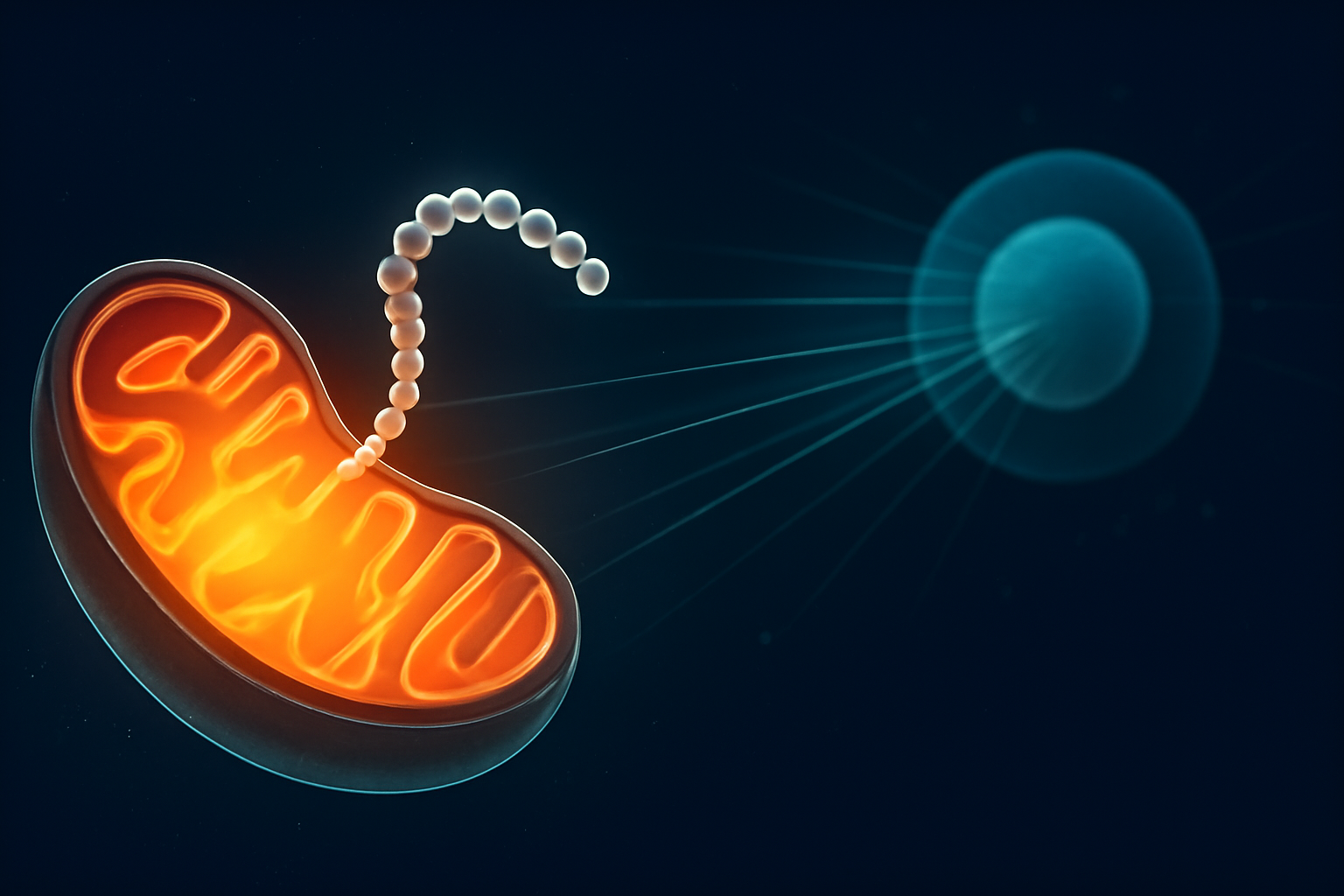
The textbook view of mitochondria was simple: little organelles that make ATP. In 2015, a lab at USC published a paper that broke the frame — mitochondrial DNA, it turned out, encodes small signalling peptides that act on the rest of the cell and the rest of the body. The first and most studied of these is MOTS-c: a 16-amino-acid peptide that regulates insulin sensitivity, glucose metabolism, exercise response, and markers of metabolic aging. A decade later, MOTS-c has become one of the most interesting peptides in research biology — a native signalling molecule, not a drug analogue of one.
Key Takeaways
- MOTS-c is encoded in mitochondrial DNA within the 12S rRNA gene — a "mitochondrially derived peptide" (MDP).
- 16 amino acids long. Discovered by Changhan Lee and Pinchas Cohen's lab at USC (reported in Cell Metabolism, 2015).
- Primary mechanism: activates AMPK, enhances insulin sensitivity, regulates the folate–methionine cycle, and modulates nuclear gene expression in response to metabolic stress.
- Levels decline with age in human skeletal muscle and circulation — associated with insulin resistance, reduced exercise capacity, and metabolic inflexibility.
- Exercise raises MOTS-c expression in muscle. Many of exercise's metabolic benefits may be partly MOTS-c-mediated.
- Preclinical only. No approved therapeutic uses. All human data is biomarker and association work, not interventional trials.
What Is a Mitochondrially Derived Peptide?
Mitochondrial DNA (mtDNA) is a small circular genome inherited from the mother. For decades the only known mtDNA-encoded proteins were components of the electron transport chain and the mitochondrial ribosome. Starting around 2003 (with humanin), researchers began finding small open reading frames within mtDNA that encode short peptides with signalling functions — mitochondrially derived peptides (MDPs). MOTS-c is the second-discovered and most-studied.
Finding MOTS-c changed the interpretation of mitochondria from pure energy producers to metabolic signalling hubs. The mitochondrion sends chemical messages to the nucleus and to the rest of the body, telling other systems how to respond to energetic stress.
The Molecular Mechanism
MOTS-c has three documented layers of action:
- AMPK activation. MOTS-c activates AMP-activated protein kinase, the master energy sensor. This drives glucose uptake into muscle, promotes fatty acid oxidation, and inhibits anabolic pathways when cellular energy is low.
- Folate–methionine metabolism. MOTS-c inhibits de novo purine biosynthesis via the folate cycle, altering methyl-group availability and affecting one-carbon metabolism broadly.
- Nuclear translocation. Under metabolic stress, MOTS-c moves from the cytoplasm into the nucleus and binds specific transcription factors (notably NRF2), regulating expression of stress-response and metabolic genes.
The net effect is a metabolic shift toward glucose utilisation, enhanced insulin sensitivity, and improved stress tolerance.
Human Observational Data
Multiple studies have measured MOTS-c in human tissue and serum:
- Levels fall with age in both skeletal muscle and circulation
- Lower MOTS-c correlates with insulin resistance in multiple cohorts
- Trained athletes have higher muscle MOTS-c expression than sedentary controls
- Acute exercise elevates MOTS-c in muscle and circulation
- Caloric restriction and metformin both raise MOTS-c in preclinical models
The pattern is consistent: MOTS-c behaves like a marker (and possibly a mediator) of the metabolic phenotype associated with health, exercise, and longevity.
Preclinical Interventional Data
In animals, exogenous MOTS-c administration has produced:
- Improved insulin sensitivity in diet-induced obese mice
- Enhanced glucose tolerance in aged mice
- Protection against age-related loss of muscle mass and function
- Increased physical performance on treadmill endurance tests
- Protection against ischemia-reperfusion injury in cardiac and other tissues
What Is Not Established
MOTS-c is often marketed as an "exercise mimetic" or "longevity peptide." The research record is substantially more cautious than that marketing:
- No approved therapeutic use for any indication
- No completed interventional human trial of recombinant MOTS-c for a clinical endpoint
- Pharmacokinetic data in humans is limited; optimal dosing is unknown
- Long-term safety is unknown — no multi-year human exposure data exists
- Oral bioavailability is poor; most research uses injection
The science is interesting. The marketing often exceeds what the science supports.
Where the Research Is Going
Three directions are most active:
- Biomarker development: standardising MOTS-c assays for use in metabolic-disease and aging research
- Mechanism refinement: mapping the full signalling network downstream of MOTS-c, including interactions with other MDPs like humanin and SHLP peptides
- Therapeutic development: early industry work on stabilised MOTS-c analogues for metabolic indications — still preclinical
MOTS-c in Context
Among peptides of research interest, MOTS-c occupies a distinctive position:
- Unlike BPC-157 (gastric-derived synthetic analogue), MOTS-c is a native human peptide with a known gene location
- Unlike GLP-1 agonists, MOTS-c does not act through a classic cell-surface receptor pathway — it signals through AMPK and nuclear translocation
- Unlike GH secretagogues like CJC-1295 or ipamorelin, MOTS-c has no hormone-axis effect; it acts within the cell on metabolic signalling directly
Frequently Asked Questions
Is MOTS-c approved for any medical use?
No. All data is preclinical or observational. There are no approved therapeutic uses. Any clinical use is off-label and not supported by regulatory evidence.
Is MOTS-c the same as "exercise in a bottle"?
No. Exercise affects dozens of signalling pathways in parallel. MOTS-c is one node among many, and raising its level does not reproduce the full physiological response to training.
How does MOTS-c relate to AMPK?
MOTS-c activates AMPK, the cellular energy sensor. AMPK activation drives glucose uptake, fatty acid oxidation, and biogenesis of new mitochondria. Metformin also activates AMPK through a different mechanism.
Is MOTS-c the same as humanin?
No. Both are mitochondrially derived peptides (MDPs), but they're encoded by different parts of mtDNA, have different mechanisms, and act on partially overlapping but distinct signalling pathways. Humanin is more neurologically focused; MOTS-c is more metabolically focused.
Does the body make MOTS-c naturally?
Yes — MOTS-c is encoded in human mitochondrial DNA and is produced constitutively, with expression modulated by metabolic state, exercise, and age.
What are the risks of exogenous MOTS-c?
Unknown. Long-term human exposure data does not exist. In preclinical research, no overt toxicity has been reported, but systematic human safety studies have not been published.
Primary sources:
- Cell Metabolism — The Mitochondrial-Derived Peptide MOTS-c Promotes Metabolic Homeostasis (Lee et al. 2015)
- PubMed — MOTS-c research literature
- Nature Communications — Exercise induces mitochondrial-derived peptide MOTS-c
Research disclaimer: This article is an educational summary of published research on MOTS-c. MOTS-c is not approved for any clinical use. The content does not constitute medical advice.