Semaglutide branded pens (Ozempic, Wegovy) arrive pre-filled and never need reconstitution. The reconstitution question is specific to compounded or research-use lyophilized semaglutide, which ships as a dry powder in a vial that the end-user mixes with bacteriostatic water. This chart walks through the math by vial size and dose, with the syringe-mark reference for a standard U-100 insulin syringe.
Key Takeaways
- Only compounded/research semaglutide needs reconstitution. Branded Ozempic and Wegovy pens are pre-filled.
- Use bacteriostatic water, not sterile water. The 0.9% benzyl alcohol in BAC water keeps the vial usable for ~28 days refrigerated.
- The chart math is linear. Final concentration (mg/mL) = vial mg ÷ BAC water mL added.
- Standard target concentration is 2.5 mg/mL. This makes 0.25, 0.5, 1.0 mg doses easy to measure on a U-100 syringe.
- Shelf life is 28 days refrigerated once reconstituted. This is the standard working estimate; some labs report longer.
- Pin at 90°, hold 6 seconds, rotate sites. Same subcutaneous technique as branded pens.
The reconstitution math
Reconstitution math has only one equation: final concentration = vial mg ÷ volume of BAC water added. Everything else is syringe-mark bookkeeping. The practical goal is to pick a BAC water volume that leaves the dose at a clean number of insulin units.
A U-100 insulin syringe has 100 units per 1 mL. So 10 units = 0.1 mL, 20 units = 0.2 mL, and so on. For a target weekly dose, you want enough units to be measurable (not 1–2 units, which is a huge percent error) but not more than 100 (the syringe limit).
Chart: BAC water volumes by vial size
Choose the row that matches your vial. The volume column gives you a clean 2.5 mg/mL working concentration — the standard for compounded semaglutide.
| Vial size | BAC water to add | Final concentration | Final volume |
|---|---|---|---|
| 2 mg | 0.80 mL | 2.5 mg/mL | 0.80 mL |
| 5 mg | 2.00 mL | 2.5 mg/mL | 2.00 mL |
| 10 mg | 4.00 mL | 2.5 mg/mL | 4.00 mL |
| 15 mg | 6.00 mL | 2.5 mg/mL | 6.00 mL |
| 20 mg | 8.00 mL | 2.5 mg/mL | 8.00 mL |
If you prefer a different concentration — for example, a higher concentration to reduce injection volume — the math scales linearly. Adding half as much BAC water doubles the concentration and halves the required insulin units per dose.
Chart: syringe units per dose at 2.5 mg/mL
This is the practical row most patients want. Dose in mg → units on a U-100 insulin syringe at the standard 2.5 mg/mL concentration.
| Target dose | Volume to draw | Units on U-100 syringe | Phase 3 analogue |
|---|---|---|---|
| 0.10 mg (microdose) | 0.04 mL | 4 units | Below label |
| 0.15 mg (microdose) | 0.06 mL | 6 units | Below label |
| 0.25 mg | 0.10 mL | 10 units | STEP/SUSTAIN starter |
| 0.50 mg | 0.20 mL | 20 units | STEP week 5–8 |
| 1.00 mg | 0.40 mL | 40 units | SUSTAIN maintenance |
| 1.70 mg | 0.68 mL | 68 units | STEP week 13–16 |
| 2.40 mg | 0.96 mL | 96 units | STEP maintenance |
Reconstitution procedure
Standard research-grade subcutaneous peptide reconstitution:
- Set up: alcohol swabs, 3 mL syringe with a drawing needle (18G), the dry semaglutide vial, the BAC water vial.
- Swab both vial tops with alcohol and let dry.
- Draw the BAC water volume from the chart into the 3 mL syringe.
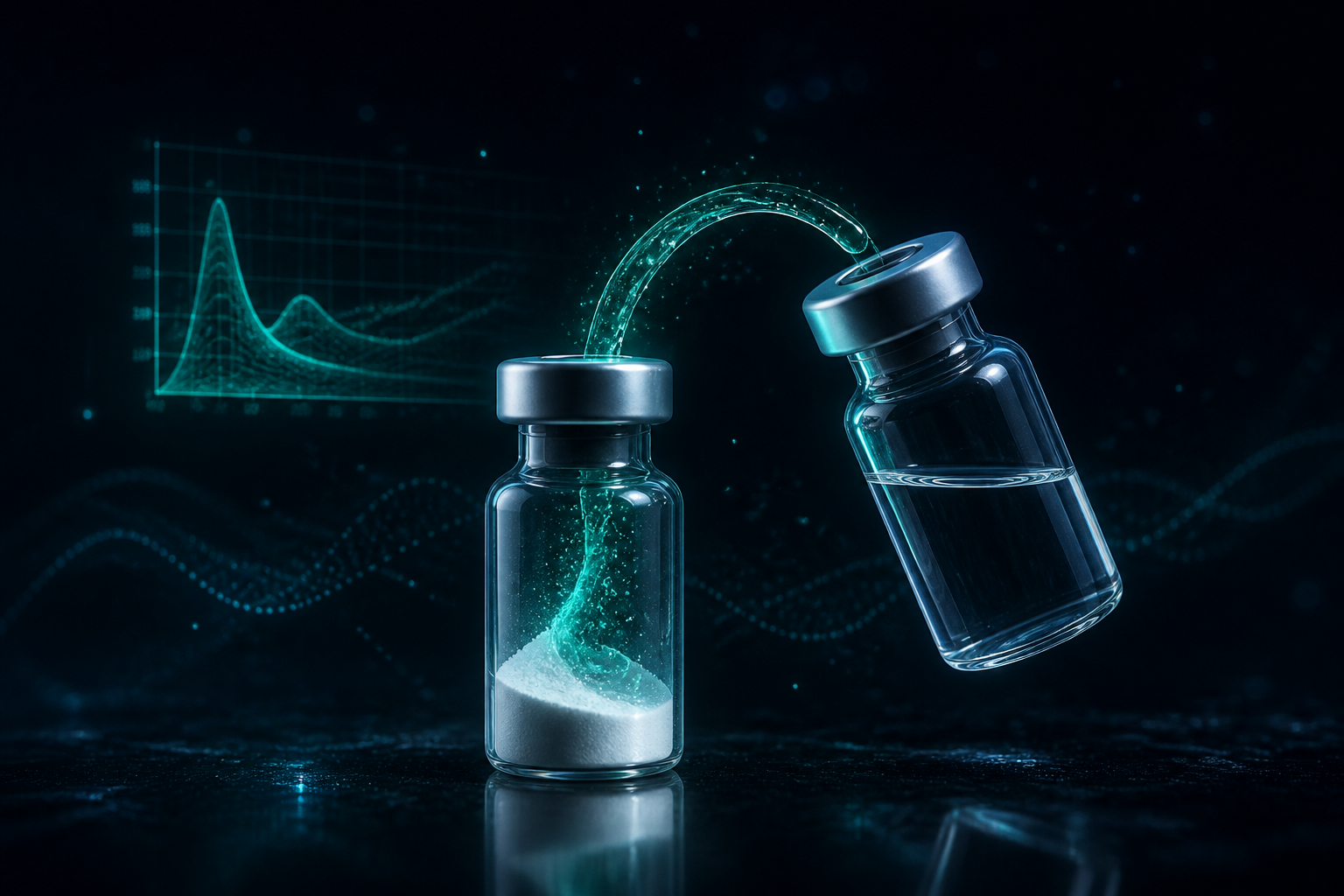
- Insert the needle at a slight angle into the semaglutide vial and let the water run down the inner wall, not directly onto the lyophilized powder. Hitting the powder directly can degrade some fraction of it.
- Swirl gently. Do not shake. Shaking creates foam, which can damage the peptide chain and makes dosing imprecise.
- Let sit 1–2 minutes to allow complete dissolution. The solution should be clear.
- Label the vial with reconstitution date and concentration. Refrigerate.
Storage and shelf life
Standard working estimates:
- Reconstituted vial — refrigerated (2–8 °C) — 28 days is the working estimate. Some stability studies suggest longer with intact BAC water preservation.
- Dry vial pre-reconstitution — refrigerated — until manufacturer expiration date.
- Freeze-thaw cycles — avoid. Freezing can damage peptide tertiary structure. One freeze is usually fine; repeated freeze-thaw is not.
- Room temperature excursions — a few hours is typically fine; days are not.
Common chart mistakes
Three errors show up repeatedly in reconstitution forums:
- Confusing mg and units. A dose of "25 units" means nothing without the concentration. Always specify.
- Using sterile water for reconstitution. Sterile water has no preservative. The vial should be used within 24 hours.
- Shaking vigorously. Shaking creates foam and can degrade the peptide. Swirl gently.
Conclusion
Semaglutide reconstitution math is linear and consistent. At the standard 2.5 mg/mL concentration, the Phase 3 dose steps translate cleanly to insulin-syringe units: 10, 20, 40, 68, 96 for the 0.25 mg → 2.4 mg ladder. Vial size dictates how much BAC water to add to hit that concentration. The procedure is straightforward if you draw the water, let it run down the vial wall, swirl rather than shake, and label the vial with reconstitution date for the 28-day refrigerated shelf-life window. This is research-grade work; it is not a substitute for an FDA-approved branded pen.
Frequently Asked Questions
How much BAC water do I use for a 5 mg semaglutide vial?
2 mL for a 2.5 mg/mL working concentration. This gives you clean 10-unit = 0.25 mg dose math on a U-100 insulin syringe.
How many units of semaglutide is a 0.25 mg dose?
10 units on a U-100 insulin syringe, at the standard 2.5 mg/mL concentration.
Can I use sterile water instead of bacteriostatic water?
Sterile water lacks the preservative. The vial should be used within 24 hours. For 28-day refrigerated shelf life, use bacteriostatic water (0.9% benzyl alcohol).
How long does reconstituted semaglutide last?
Approximately 28 days refrigerated. Some stability data support longer with BAC water. Discard if cloudy or discolored.
Should I shake the vial after adding BAC water?
No. Shaking creates foam and can degrade peptide structure. Swirl gently and let sit 1–2 minutes.
Can I draw semaglutide into an Ozempic pen?
No — Ozempic pens are not refillable and will not deliver accurate doses from a user-loaded cartridge. Use a U-100 insulin syringe.
Primary sources:
- Ozempic prescribing information
- FDA human drug compounding Q&A
- Clinical pharmacology of semaglutide — Clinical Pharmacokinetics 2019
- FITTER injection technique recommendations
- USP standards on compounding and stability
Research disclaimer: This article is a research review for educational use only. It is not medical advice. Reconstitution of compounded peptides should be performed in a research or clinical setting with sterile technique. Compounded semaglutide is not FDA-approved and quality varies between compounding pharmacies. Discuss any protocol with a qualified clinician.
Sources & Further Reading
Peer-reviewed clinical trial data and research publications underpinning this article. See our full research library.
- Wilding JPH, Batterham RL, Calanna S, et al. (2021). Once-Weekly Semaglutide in Adults with Overweight or Obesity. New England Journal of Medicine, 384:989–1002. Phase 3 RCT
- Lincoff AM, Brown-Frandsen K, Colhoun HM, et al. (2023). Semaglutide and Cardiovascular Outcomes in Obesity without Diabetes (SELECT). New England Journal of Medicine, 389:2221–2232. Phase 3 RCT